


At the heart of the FOP Drug Development Forum (DDF) is a shared goal: advancing the development of safe and effective medicines to treat and prevent the life-altering symptoms of FOP. As the premier biennial international scientific conference focused on FOP drug development, the Forum brings together researchers, clinicians, industry professionals, regulators, and members of the FOP community to share discoveries, build connections, and turn new ideas into potential treatments.
Last weekend, August 27-30, the seventh DDF took place in Toronto, Canada, providing a space for two and a half days of scientific exchange, collaboration, and discovery. The hybrid meeting welcomed participants from around the world, creating opportunities to share the latest research and strengthen connections in the FOP research community.
From a scientific workshop to a biennial event

The origins of the DDF actually began in 2011, with the Scientific Workshop for a Cure: Strategies for the Treatment of FOP, held in Philadelphia. Twenty-seven scientists from different institutions gathered to discuss strategies for developing treatments for FOP.
In 2014, the gathering evolved into the FOP Drug Development Forum and was held in Boston. Subsequent Forums took place in Boston again in 2016; Sardinia, Italy, in 2017; Orlando, Florida, in 2019; Dallas, Texas, in 2022; and Stockholm, Sweden, in 2024. The event now takes place every other year, alternating between Europe and North America.
Alex Bullock, PhD, an academic researcher at the University of Oxford, has attended every Forum since 2014 and has witnessed that evolution firsthand.
“The main change has been from merely having hope of new treatments entering into clinical trials to actually having multiple clinical trials conclude and, furthermore, read out with truly encouraging results,” he shares.
That progress reflects how much scientists have learned about FOP biology over the past 15 years. As knowledge has grown, so has the range of ideas for potential treatments, from new drug targets and modalities to approaches that would have been difficult to imagine when the first workshop took place.
And the research community continues to expand. The DDF encourages participation from early-career investigators and includes opportunities for researchers to share emerging work through scientific posters and presentations.
The 2026 FOP Drug Development Forum brought together nearly 200 attendees from 27 countries; 20 percent of attendees participated virtually.


The event included:
- Keynote address from Nobel Laureate Craig Mello, PhD, University of Massachusetts Chan Medical School
- 37 FOP Talks
- 45 Scientific Posters
- Opening address from a person living with FOP
- Two panels filled with the voices of patients and parents
- Closing address from an FOP parent
Michelle Davis, Executive Director, shared, “It was exciting to be together right after the approval of Regeneron’s FOP drug garetosmab on August 19, and as we wait for the FDA to make a decision on Mirum’s FOP drug zilurgisertib in September. But what was incredible is seeing how much research continues to be pursued to learn more about FOP and explore additional treatment options. I also loved meeting the more than 17 early-career investigators and seeing their dedication to FOP research. They are the future of our research community.”
Where science meets lived experience
What makes the DDF unique is not simply the breadth of science being discussed. It’s the people in the room.
Academic researchers, clinician scientists, and members of the pharmaceutical industry all bring a different perspective to the same conversation. A key focus of the DDF is patient-focused drug development. Patient and parent-focused panels and talks ensure the lived experience of FOP remains central to discussions about research and drug development.
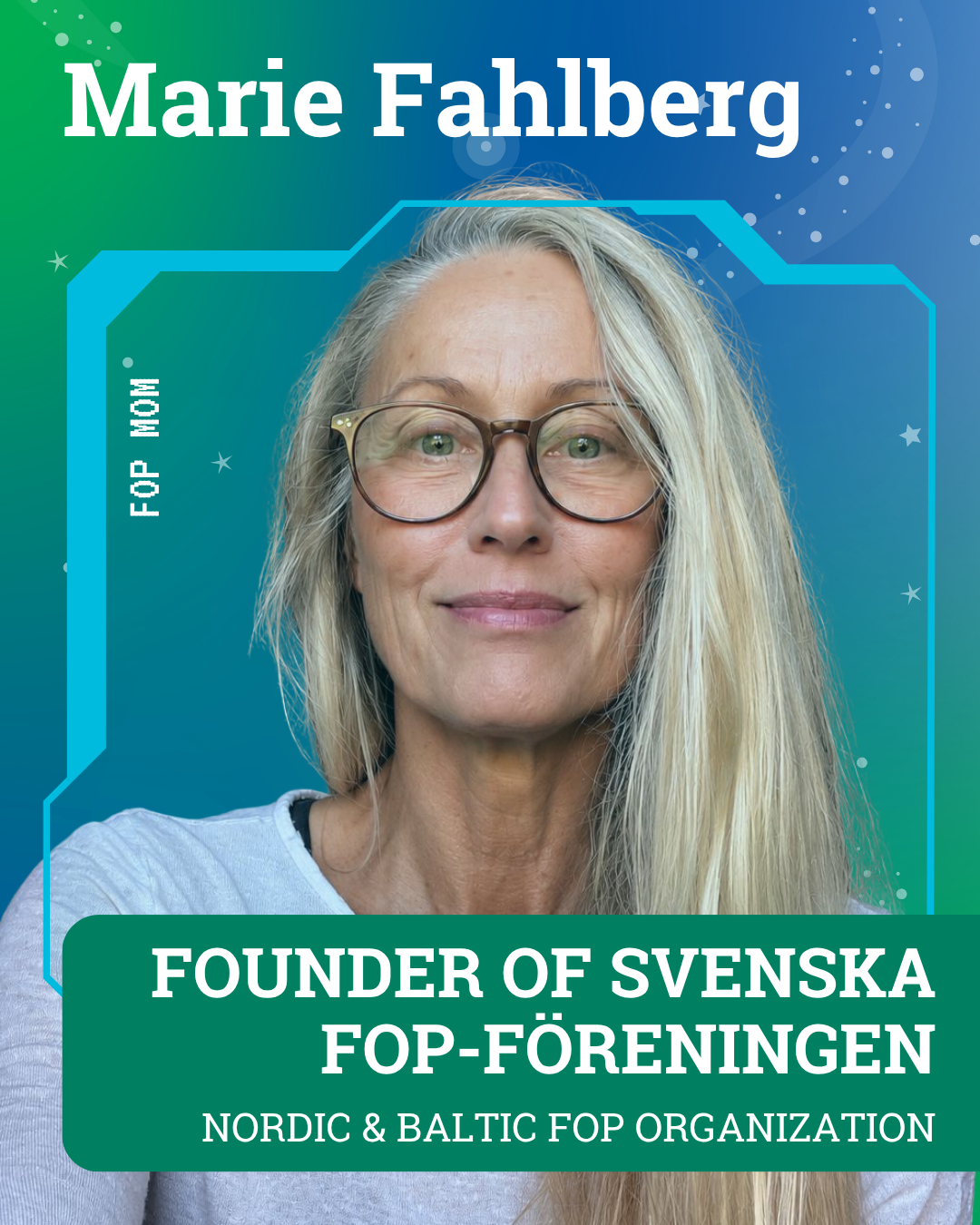 Marie Hallbert Fahlberg, a FOP parent and founder of Nordic and Baltic FOP organization Svenska FOP-föreningen, attended her first DDF in 2014. For her, seeing that multidisciplinary collaboration grow has been one of the most meaningful parts of the DDF’s evolution.
“What makes the Drug Development Forum unique is that everyone who plays a role in developing future treatments is sitting in the same room,” Marie says.
She has seen firsthand how conversations between attendees can create connections that might not happen through scientific publication alone.
Dr. Bullock has experienced the same value from an academic perspective. He notes that the diverse community represented at the DDF has been critical to his own work, including the STOPFOP clinical trial. “Our own STOPFOP clinical trial would not have been possible without this diverse multi-stakeholder community.”
Patient voices also directly influence how researchers think about clinical trials. As Alex explains, understanding the natural history of FOP helps researchers consider questions such as what constitutes a flare-up, what factors matter for trial enrollment, and which concerns need to be addressed for patients and families.
Marie describes this connection: behind every biomarker, clinical endpoint, and research finding is a person hoping for a better future.
“The DDF has helped build trust between the scientific community and the global FOP community, and I believe that trust has been essential to the progress we have seen.”
Looking forward to what comes next for FOP research
The DDF program reflects the full journey of drug development, moving from approved treatments and clinical trials to drug repurposing and emerging discoveries about the biology of FOP. Research presented at past Forums has explored areas including gene therapy, non-genetic heterotopic ossification, variant forms of FOP, and progressive osseous heterosplasia (POH). New topics in 2026 included real-world evidence with palovarotene, surgery and FOP, and FOP case studies. It’s important to note that the vast majority of the talks given at the DDF are unpublished data which is why the IFOPA can’t share the talks that were given. However, as the research is published, we will share those publications with the community.
Today, there is a sense of momentum across the FOP research community. The 2026 DDF came at a particularly exciting time, with clinical research generating new knowledge while researchers continue to explore the next generation of potential therapies.
For Alex, that progress creates optimism, but also important new questions about what comes after clinical trials. “I see great optimism in how the impact of clinical trials will forge even stronger links between patient families with FOP researchers.”
Maries shares that optimism, especially when she considers how far the community has come since her first Forum. “We are no longer simply hoping for progress—we are watching it happen, one step at a time.”
The DDF is a reminder that progress doesn’t happen in isolation. It happens when researchers share discoveries, clinicians bring their experiences, industry and regulators work together, and patients and families have a voice in the process.
Every connection made and every discovery shared brings the FOP community another step closer to a future with better treatments and a cure.
You can help make that future possible. Give to IFOPA’s In Pursuit of a Cure campaign and support the research, collaboration, and hope that continue to move the FOP community forward.
